Why in News?
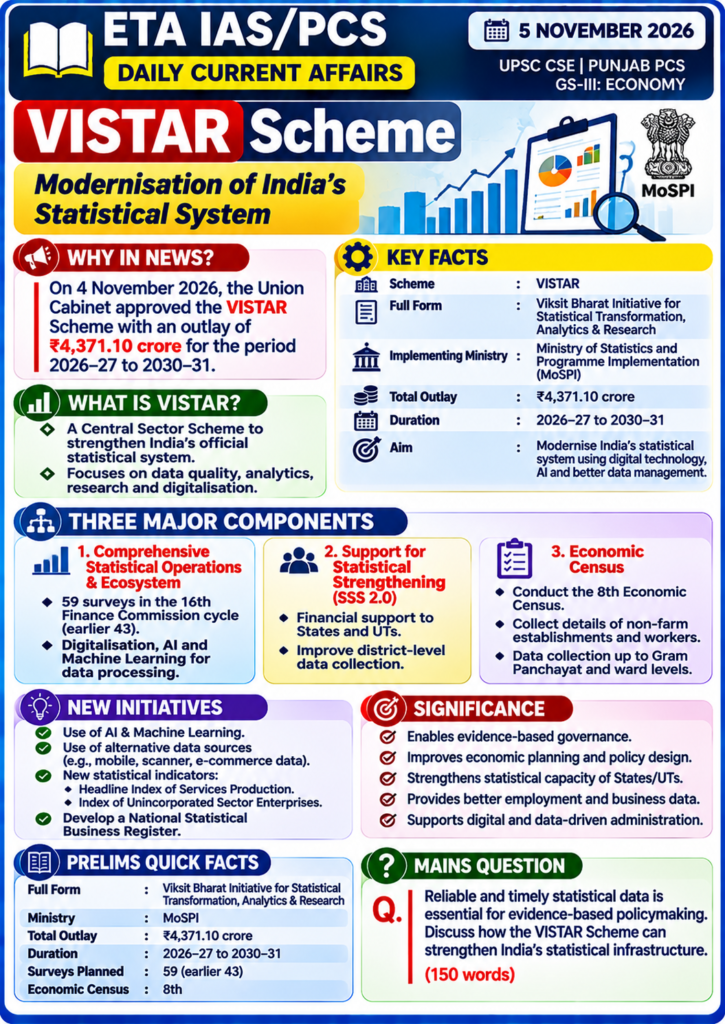
On 4 November 2026, the Union Cabinet approved the Viksit Bharat Initiative for Statistical Transformation, Analytics & Research (VISTAR) Scheme with an outlay of ₹4,371.10 crore for the period 2026–27 to 2030–31. Prime Minister of India+1
1. What is the VISTAR Scheme?
- A Central Sector Scheme approved by the Union Cabinet.
- Implemented by the Ministry of Statistics and Programme Implementation (MoSPI).
- Total outlay: ₹4,371.10 crore.
- Duration: Five years (2026–27 to 2030–31).
- Aim: Modernise India’s official statistical system using digital technology, AI and improved data management. Prime Minister of India
2. Three Major Components
1. Comprehensive Statistical Operations and Strengthening of Ecosystem
- 59 surveys planned during the 16th Finance Commission cycle, compared with 43 earlier.
- Digitalisation of statistical processes.
- Use of AI and Machine Learning for data processing and analysis.2. Support for Statistical Strengthening (SSS 2.0)
- Financial support to States and Union Territories.
- Improve district-level data collection.
- Strengthen local statistical infrastructure.3. Economic Census
- Conduct the 8th Economic Census.
- Collect details of non-farm establishments and their workers.
- Data collection up to Gram Panchayat and ward levels.
Prime Minister of India+1
3. Important New Initiatives
- AI and Machine Learning: Improve data validation, processing and analysis.
- Alternative Data Sources: Use mobile phone, scanner and e-commerce data alongside traditional surveys.
- New Statistical Indicators:
- Headline Index of Services Production.
- Index of Unincorporated Sector Enterprises.
- National Statistical Business Register: The 8th Economic Census will provide the baseline for developing this register. Prime Minister of India
4. What is an Economic Census?
An Economic Census is a complete count of economic establishments operating in a country, along with information about their activities and workers.
Importance:
- Helps understand the unorganised sector.
- Supports business and employment-related policymaking.
- Improves economic data at local levels.
- Helps estimate the contribution of the unorganised sector to GDP.
5. Significance of the VISTAR Scheme
- Evidence-based governance: Better data helps governments make informed decisions.
- Economic planning: Reliable statistics improve policy formulation.
- Digital governance: AI and digital systems can improve data processing.
- Federal development: Strengthens statistical capacity of States and UTs.
- Better employment data: More detailed surveys can improve understanding of labour-market trends.
6. Challenges
- Maintaining data privacy and security.
- Ensuring accuracy of alternative data sources.
- Reducing the digital divide between States.
- Developing skilled statistical professionals.
- Ensuring consistency and comparability of datasets.
Prelims Quick Facts
| Question | Answer |
|---|---|
| Full form of VISTAR | Viksit Bharat Initiative for Statistical Transformation, Analytics & Research |
| Implementing ministry | MoSPI |
| Total outlay | ₹4,371.10 crore |
| Duration | 2026–27 to 2030–31 |
| Surveys planned | 59 |
| Earlier major surveys | 43 |
| Economic Census | 8th |
| SSS framework | SSS 2.0 |
UPSC Mains Practice Question
Q. Reliable and timely statistical data is essential for evidence-based policymaking. Discuss how the VISTAR Scheme can strengthen India’s statistical infrastructure.