Why in News?
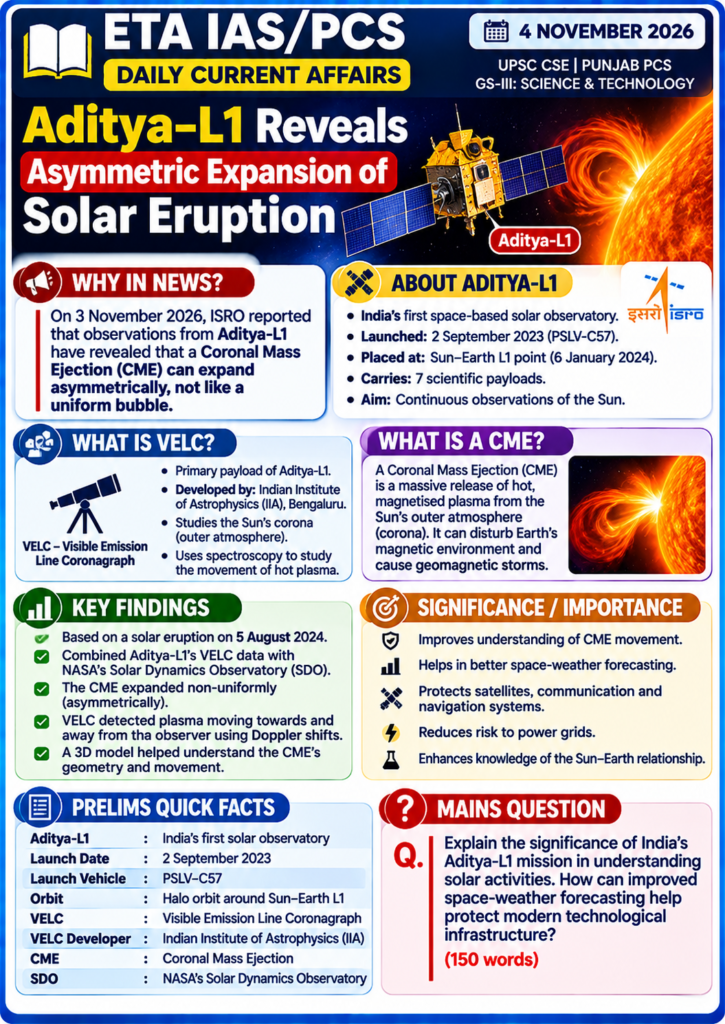
On 3 November 2026, ISRO reported that observations from India’s first space-based solar observatory, Aditya-L1, have revealed that a Coronal Mass Ejection (CME) does not always expand uniformly like a symmetrical bubble. Instead, it can develop an asymmetric shape. This finding is important for improving space-weather studies. Press Information Bureau+1
1. What is Aditya-L1?
- India’s first space-based observatory dedicated to studying the Sun.
- Launched on 2 September 2023 by PSLV-C57.
- Placed in a halo orbit around the Sun–Earth L1 point on 6 January 2024.
- Carries 7 scientific payloads.
- Provides continuous observations of the Sun. isro.gov.in+1
2. What is VELC?
VELC – Visible Emission Line Coronagraph
- It is the primary payload of Aditya-L1.
- Developed by the Indian Institute of Astrophysics (IIA), Bengaluru, with substantial support from ISRO.
- Studies the Sun’s outer atmosphere, known as the corona.
- Uses spectroscopy to study the movement of hot plasma.
- Helps scientists observe the early stages of solar eruptions. Press Information Bureau+1
3. What is a Coronal Mass Ejection (CME)?
A Coronal Mass Ejection (CME) is a massive release of hot, magnetised plasma from the Sun’s outer atmosphere (corona).
When directed towards Earth, CMEs can disturb Earth’s magnetic environment and cause geomagnetic storms.
4. Major Findings of the Study
- Scientists studied a solar eruption that occurred on 5 August 2024.
- They combined Aditya-L1’s VELC observations with NASA’s Solar Dynamics Observatory (SDO) images.
- The study found that the CME expanded non-uniformly, developing an asymmetric shape.
- VELC detected plasma moving both towards and away from the observer using Doppler shifts.
- A 3D model helped scientists understand the CME’s geometry and movement. ISRO
5. What is the Doppler Effect?
The Doppler Effect is the change in the observed wavelength or frequency of light due to the motion of its source.
- Blue shift: Plasma moving towards the observer.
- Red shift: Plasma moving away from the observer.
VELC uses this principle to study the movement of solar plasma.
6. Why is this Discovery Important?
- Improves understanding of CME movement and expansion.
- Can help improve predictions of CME speed and arrival time at Earth.
- Supports better space-weather forecasting.
- Helps protect satellites, communication networks and navigation systems.
- Improves scientific understanding of the Sun–Earth relationship. Press Information Bureau+1
7. What is Space Weather?
Space weather refers to changing environmental conditions in space caused mainly by solar activity, including solar flares and CMEs.
Possible impacts:
- Disruption of satellite operations.
- GPS and navigation errors.
- Radio communication disturbances.
- Geomagnetic storms.
- Possible disturbances to power-grid operations.
Prelims Quick Facts
| Term | Important Fact |
|---|---|
| Aditya-L1 | India’s first space-based solar observatory |
| Launch | 2 September 2023 |
| Launch vehicle | PSLV-C57 |
| Orbit | Halo orbit around Sun–Earth L1 |
| VELC | Visible Emission Line Coronagraph |
| VELC developer | Indian Institute of Astrophysics |
| CME | Coronal Mass Ejection |
| SDO | NASA’s Solar Dynamics Observatory |
UPSC Mains Practice Question
Q. Explain the significance of India’s Aditya-L1 mission in understanding solar activities. How can improved space-weather forecasting help protect modern technological infrastructure?