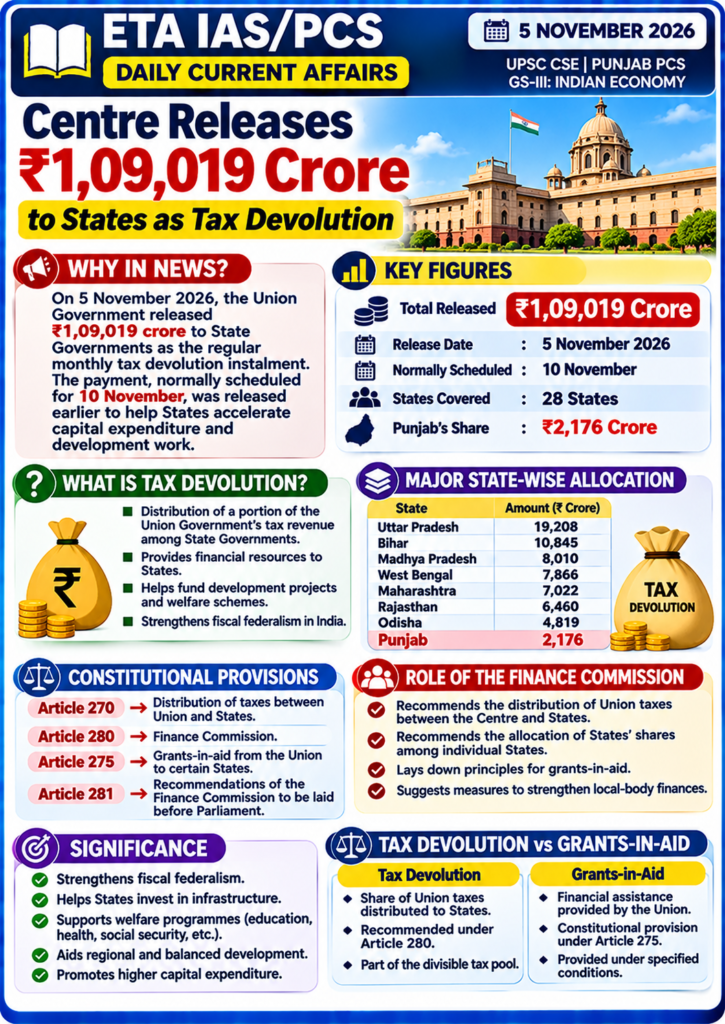
Why in News?
On 5 November 2026, the Union Government released ₹1,09,019 crore to State Governments as the regular monthly tax devolution instalment. The payment, normally scheduled for 10 November, was released five days early to help States accelerate capital expenditure and meet development and welfare-related expenses. Press Information Bureau
1. What is Tax Devolution?
Tax devolution refers to the distribution of a portion of the Union Government’s tax revenue among State Governments.
- It provides financial resources to States.
- Helps States fund development projects.
- Supports welfare schemes and public services.
- Promotes fiscal federalism in India.
2. Important Figures
Total released
₹1,09,019 Cr
Release date
5 Nov 2026
Normally scheduled
10 November
States covered
28 States
Punjab’s allocation
₹2,176 crore
Source: Ministry of Finance, PIB, 5 November 2026.Press Information Bureau
3. State-wise Major Allocations
| State | Amount |
|---|---|
| Uttar Pradesh | ₹19,208 Cr |
| Bihar | ₹10,845 Cr |
| Madhya Pradesh | ₹8,010 Cr |
| West Bengal | ₹7,866 Cr |
| Maharashtra | ₹7,022 Cr |
| Rajasthan | ₹6,460 Cr |
| Odisha | ₹4,819 Cr |
| Punjab | ₹2,176 Cr |
Source: PIB, Ministry of Finance. Press Information Bureau
4. Constitutional Provisions
These Articles are important for UPSC Prelims:
- Article 270: Taxes levied and collected by the Union and distributed between the Union and States.
- Article 280: Provides for the Finance Commission.
- Article 275: Grants-in-aid from the Union to certain States.
- Article 281: Recommendations of the Finance Commission to be laid before Parliament.
5. Role of the Finance Commission
The Finance Commission is a constitutional body established under Article 280.
Its major functions include:
- Recommending the distribution of tax revenues between the Union and States.
- Recommending the allocation of States’ shares among individual States.
- Recommending principles governing grants-in-aid.
- Suggesting measures to strengthen local-body finances.
Important: The Finance Commission is generally constituted every five years or earlier by the President.
6. Why is Tax Devolution Important?
- Fiscal federalism: Strengthens financial relations between the Union and States.
- Infrastructure: Helps States invest in roads, bridges and public transport.
- Welfare: Supports education, healthcare and social-security programmes.
- Regional development: Helps States meet their expenditure requirements.
- Capital expenditure: Supports long-term productive investment.
7. Tax Devolution vs Grants-in-Aid
| Tax Devolution | Grants-in-Aid |
|---|---|
| Share of Union taxes distributed to States | Financial assistance provided by Union |
| Recommended under Article 280 | Constitutional provision under Article 275 |
| Part of divisible tax pool | Provided under specified conditions |
Prelims Quick Facts
| Question | Answer |
|---|---|
| Tax devolution | Distribution of Union tax revenue |
| Article 280 | Finance Commission |
| Article 270 | Distribution of Union taxes |
| Article 275 | Grants-in-aid |
| November 2026 release | ₹1,09,019 crore |
| Punjab’s share | ₹2,176 crore |
| Total States covered | 28 |
UPSC Mains Practice Question
Q. Explain the role of tax devolution in strengthening fiscal federalism in India. Discuss the importance of the Finance Commission in Centre–State financial relations.