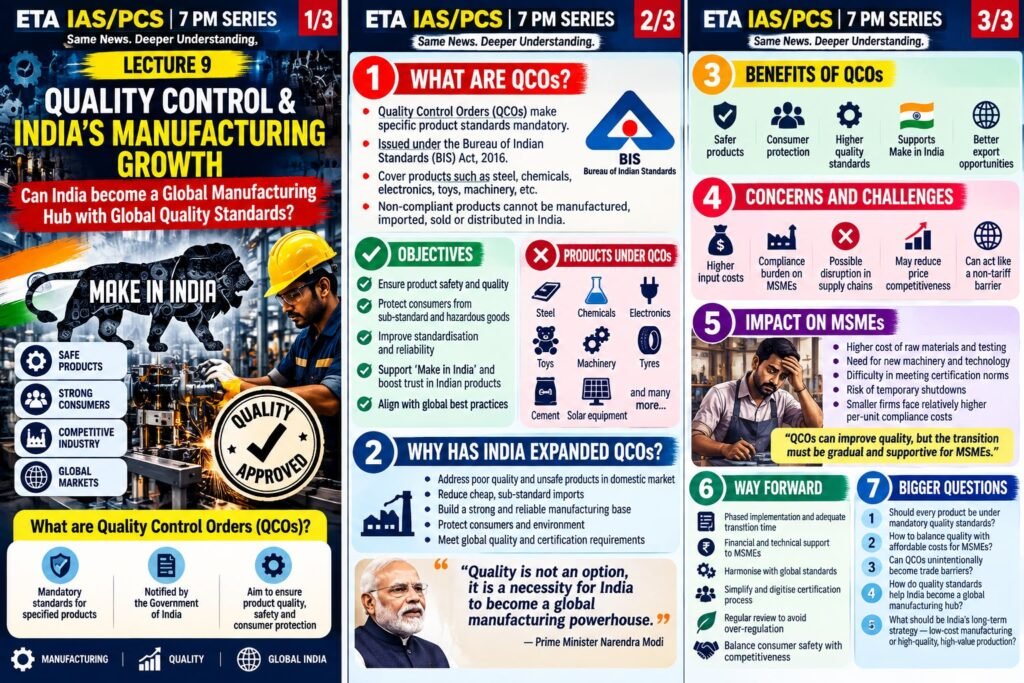
INDIA’S MANUFACTURING
GROWTH
Can India become a Global Manufacturing Hub with Global Quality Standards?
MAKE IN INDIA
- SAFE PRODUCTS
- STRONG CONSUMERS
- COMPETITIVE INDUSTRY
- GLOBAL MARKETS
What are Quality Control Orders (QCOs)?
Mandatory
standards for specified products
Notified by
the Government of India
Aim to ensure
product quality, safety and consumer protection
MANUFACTURING | QUALITY | GLOBAL INDIAQUALITY CONTROL &
INDIA’S MANUFACTURING
1 WHAT ARE QCOs?
- Quality Control Orders (QCOs) make specific product standards mandatory.
- Issued under the Bureau of Indian Standards (BIS) Act, 2016.
- Cover products such as steel, chemicals, electronics, toys, machinery, etc.
- Non-compliant products cannot be manufactured, imported, sold or distributed in India.
OBJECTIVES
✓ Ensure product safety and quality
✓ Protect consumers from sub-standard and hazardous goods
✓ Improve standardisation and reliability
✓ Support ‘Make in India’ and boost trust in Indian products
✓ Align with global best practices
PRODUCTS UNDER QCOs
- Steel
- Chemicals
- Electronics
- Toys
- Machinery
- Tyres
- Cement
- Solar equipment
- and many more…
2 WHY HAS INDIA EXPANDED QCOs?
- Address poor quality and unsafe products in domestic market
- Reduce cheap, sub-standard imports
- Build a strong and reliable manufacturing base
- Protect consumers and environment
- Meet global quality and certification requirements
“Quality is not an option,
it is a necessity for India
to become a global
manufacturing powerhouse.”
— Prime Minister Narendra Modi
3 BENEFITS OF QCOs
- Safer products
- Consumer protection
- Higher quality standards
- Supports Make in India
- Better export opportunities
4 CONCERNS AND CHALLENGES
- Higher input costs
- Compliance burden on MSMEs
- Possible disruption in supply chains
- May reduce price competitiveness
- Can act like a non-tariff barrier
5 IMPACT ON MSMEs
- Higher cost of raw materials and testing
- Need for new machinery and technology
- Difficulty in meeting certification norms
- Risk of temporary shutdowns
- Smaller firms face relatively higher per-unit compliance costs
“QCOs can improve quality, but the transition must be gradual and supportive for MSMEs.”
6 WAY FORWARD
- Phased implementation and adequate transition time
- Financial and technical support to MSMEs
- Harmonise with global standards
- Simplify and digitise certification process
- Regular review to avoid over-regulation
- Balance consumer safety with competitiveness
7 BIGGER QUESTIONS
- Should every product be under mandatory quality standards?
- How to balance quality with affordable costs for MSMEs?
- Can QCOs unintentionally become trade barriers?
- How do quality standards help India become a global manufacturing hub?
- What should be India’s long-term strategy — low-cost manufacturing or high-quality, high-value production?