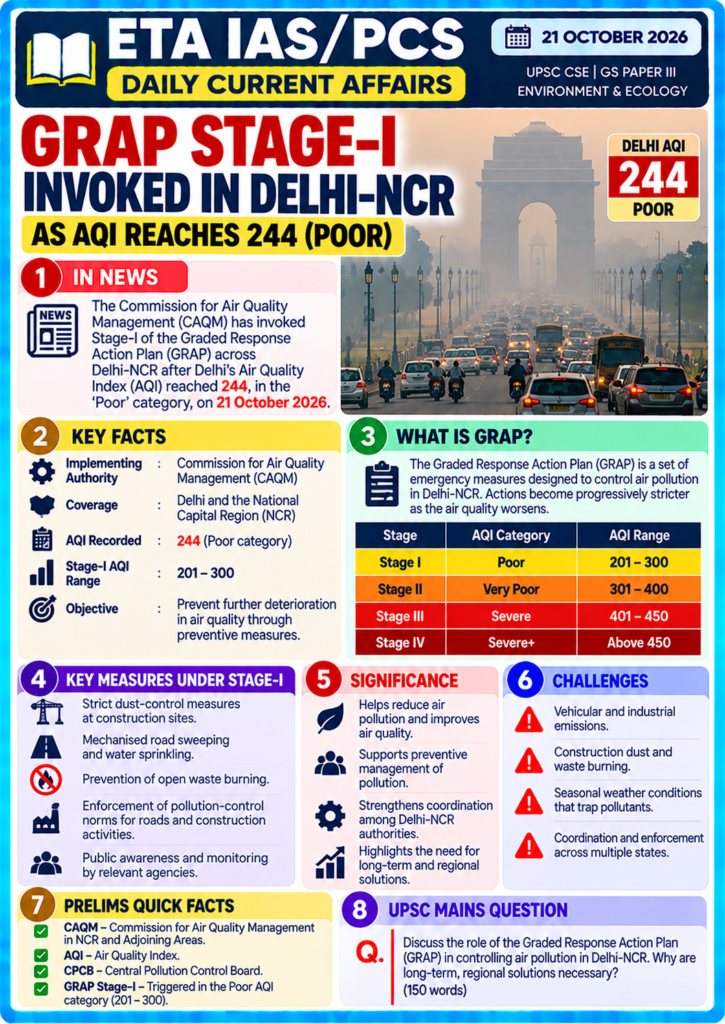
Why in the News?
The Commission for Air Quality Management (CAQM) invoked Stage-I of the Graded Response Action Plan (GRAP) across Delhi-NCR after Delhi’s Air Quality Index (AQI) reached 244, categorised as Poor, at 2 PM on 21 October 2026.
Akashvani News
Key facts
- Implementing authority: Commission for Air Quality Management (CAQM).
- Coverage: Delhi and the National Capital Region (NCR).
- AQI recorded: 244 — Poor category.
- Stage-I AQI range: 201–300.
- Objective: Prevent further deterioration in air quality through preventive pollution-control measures.
CAQM+1
What is GRAP?
The Graded Response Action Plan is a set of emergency measures designed to control air pollution in Delhi-NCR. Actions become progressively stricter as air quality worsens.
| Stage | AQI category | AQI range |
|---|---|---|
| Stage I | Poor | 201–300 |
| Stage II | Very Poor | 301–400 |
| Stage III | Severe | 401–450 |
| Stage IV | Severe+ | Above 450 |
Key measures under Stage-I
- Strict dust-control measures at construction sites.
- Mechanised road sweeping and water sprinkling.
- Prevention of open waste burning.
- Enforcement of pollution-control norms for roads and construction activities.
- Public awareness and monitoring by relevant agencies.
Significance
- Supports preventive air-pollution management.
- Helps reduce particulate matter from road dust and construction.
- Improves coordination among Delhi-NCR authorities.
- Highlights the need for long-term emission reduction and regional cooperation.
Challenges
- Vehicular and industrial emissions.
- Construction dust and waste burning.
- Seasonal weather conditions that trap pollutants.
- Coordination and enforcement across multiple states.
Prelims quick facts
- CAQM: Commission for Air Quality Management in National Capital Region and Adjoining Areas.
- AQI: Air Quality Index.
- CPCB: Central Pollution Control Board.
- GRAP Stage-I: Triggered in the Poor AQI category, 201–300.
UPSC Mains question
Q. Discuss the role of the Graded Response Action Plan in controlling air pollution in Delhi-NCR. Why are long-term, regional solutions necessary? (150 words)