UPSC CSE | GS PAPER II – POLITY & GOVERNANCE
1. IN NEWS
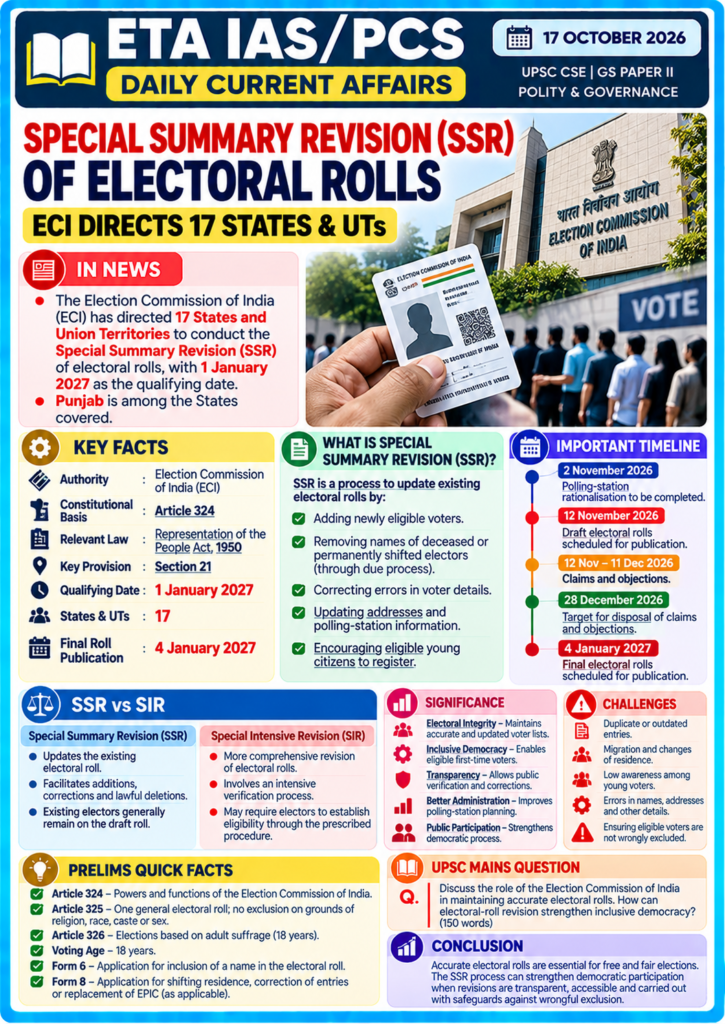
The Election Commission of India (ECI) has directed 17 States and Union Territories to undertake the Special Summary Revision (SSR) of electoral rolls, with 1 January 2027 as the qualifying date. The exercise is intended to update voter lists and enrol eligible electors. Punjab is among the States covered.
2. KEY FACTS
- Constitutional Authority: Article 324
- Relevant Law: Representation of the People Act, 1950
- Key Provision: Section 21
- Qualifying Date: 1 January 2027
- States and UTs Covered: 17
- Final Electoral Rolls: Scheduled for publication on 4 January 2027
3. WHAT IS SPECIAL SUMMARY REVISION?
SSR is a process used to update existing electoral rolls by:
- Adding newly eligible voters.
- Removing names of deceased or permanently shifted electors through due process.
- Correcting errors in voter details.
- Updating addresses and polling-station information.
- Encouraging eligible young citizens to register.
4. SSR VS SIR
Special Summary Revision (SSR)
- Updates the existing electoral roll.
- Facilitates additions, corrections and lawful deletions.
- Existing electors generally remain on the draft roll.
Special Intensive Revision (SIR)
- A more comprehensive revision of electoral rolls.
- Involves an intensive verification process.
- May require electors to establish eligibility through the prescribed procedure.
5. IMPORTANT TIMELINE
- 2 November 2026: Polling-station rationalisation to be completed.
- 12 November 2026: Draft electoral rolls scheduled for publication.
- 12 November – 11 December 2026: Claims and objections.
- 28 December 2026: Target for disposal of claims and objections.
- 4 January 2027: Final electoral rolls scheduled for publication.
These dates apply to the current SSR exercise in the specified States and UTs.
6. SIGNIFICANCE
- Electoral Integrity: Helps maintain accurate voter lists.
- Inclusive Democracy: Enables eligible first-time voters to enrol.
- Transparency: Allows voters to check entries and submit corrections.
- Better Administration: Improves polling-station planning and electoral management.
- Public Participation: Encourages citizens to verify their registration.
7. CHALLENGES
- Duplicate or outdated entries.
- Migration and changes of residence.
- Low awareness among young and first-time voters.
- Errors in names, addresses and other personal details.
- Ensuring that eligible voters are not wrongly excluded.
8. PRELIMS QUICK FACTS
- Article 324: Powers and functions of the Election Commission of India.
- Article 325: One general electoral roll; prohibits exclusion from electoral rolls on grounds only of religion, race, caste or sex.
- Article 326: Elections to the Lok Sabha and State Legislative Assemblies based on adult suffrage, subject to constitutional provisions.
- Voting Age: 18 years.
- Form 6: Application for inclusion of a name in the electoral roll.
- Form 8: Application for shifting residence, correction of entries or replacement of the EPIC, as applicable.
9. UPSC MAINS QUESTION
Q. Discuss the role of the Election Commission of India in maintaining accurate electoral rolls. How can electoral-roll revision strengthen inclusive democracy? (150 words)
CONCLUSION
Accurate electoral rolls are essential for free and fair elections. The SSR process can strengthen democratic participation when revisions are transparent, accessible and carried out with safeguards against wrongful exclusion.
ETA IAS/PCS | Prepare Today, Lead Tomorrow