
CONTEXT: As India progresses on its path to achieving gender equality, the Beijing Platform for Action continues to serve as an essential framework.
About the Beijing Platform for Action
Beijing Declaration: A resolution adopted by the United Nations (UN) at the conclusion of the Fourth World Conference on Women in September 1995.
Purpose: The resolution was designed to promote a set of principles aimed at achieving gender equality between men and women.
Key Areas of Focus: The platform covers 12 critical issues and areas for action, seen as the main barriers to empowering women.
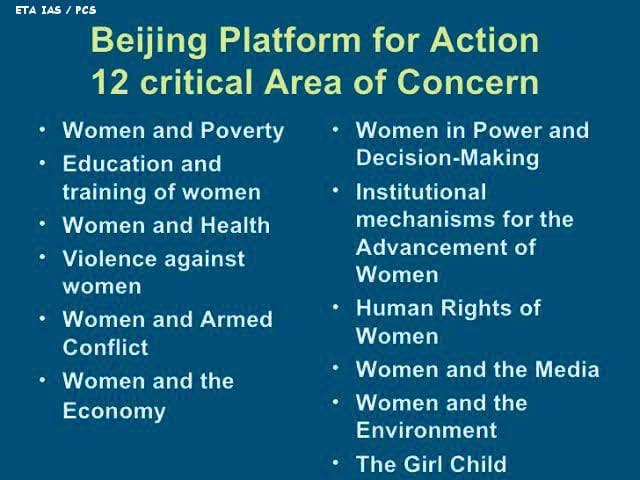
India’s Progress in Promoting Women’s Rights
Maternal and Reproductive Health:
Institutional Deliveries: The rate has risen to 95% due to programs like the PM Surakshit Matritva Abhiyan and PM Matru Vandana Yojana.
Maternal Mortality Rate (MMR): The MMR has dropped from 130 in 2014 to 97 in 2020 per 100,000 live births, according to Sample Registration System data.
Modern Contraceptive Use: 56.5% of married women now use modern contraceptives, enhancing reproductive autonomy.
Women’s Access to Healthcare:
- Ayushman Bharat Pradhan Mantri Jan Arogya Yojana: The world’s largest government-funded healthcare initiative has provided millions of women with free medical treatment.
Education and Skill Development:
Improvement in Child Sex Ratio: Achieved through initiatives like Beti Bachao Beti Padhao (BBBP).
Higher Retention Rates in Education: The National Education Policy 2020 has integrated education with skills training.
STEM Opportunities for Women: Efforts have been made to encourage women’s participation in Science, Technology, Engineering, and Mathematics (STEM).
Menstrual Hygiene Support: Improved sanitation has reduced school absenteeism among adolescent girls.
Women’s Economic Empowerment:
Financial Inclusion through Self-Help Groups (SHGs): The National Rural and Urban Livelihood Missions have connected 100 million women to financial networks.
Deendayal Antyodaya Yojana – National Rural Livelihood Mission: Facilitated credit and livelihood opportunities for women.
Digital Financial Inclusion:
Unified Payments Interface (UPI): Significantly increased women’s participation in digital savings and investments.
Pradhan Mantri Gramin Digital Saksharta Abhiyan: Empowered 35 million rural women with digital literacy skills.
Gender-Responsive Budgeting:
Increased Allocation: The allocation for gender-specific initiatives within the national budget has risen from 6.8% in fiscal year 2024-25 to 8.8% in 2025-26.
Total Funding: A total of $55.2 billion has been designated for programs aimed at addressing gender issues.
Women in Leadership:
New Generation of Leaders: Young women are increasingly taking leadership roles in sectors like climate action, digital entrepreneurship, and governance.
Supportive Projects: Initiatives such as the Gender Advancement for Transforming Institutions (GATI) and the G20 TechEquity Platform exemplify this shift, helping thousands of young women in STEM and emerging technologies.
Political Representation:
Women’s Reservation Act: Ensures women hold 33% of seats in legislative bodies, promoting gender balance in decision-making.
Local Governance Empowerment: Local governance initiatives have empowered 1.5 million women leaders, creating the world’s largest cohort of women in political leadership.
Actions Against Gender-Based Violence:
Ongoing Challenge: Despite legal protections, gender-based violence remains a persistent issue.
Government Initiatives:
- One Stop Centres: 770 centres have been established to provide comprehensive support, including medical, legal, and psychological services to survivors.
- Bharatiya Nyaya Sanhita 2023: Enacted in July 2024, it strengthens legal protections for women.
- Odisha Blockchain Initiative: Ensures prompt and confidential assistance for survivors of violence.
- Gender-Responsive Policing: A collaboration between the Rajasthan Police Academy and the UN Population Fund has built trust and improved access to justice for survivors.
Way Forward
30th Anniversary of the Beijing Declaration: Marks a pivotal moment in recognizing that gender equality is a global imperative, reaffirming the commitment to women’s rights and empowerment.
India’s Approach: Backed by strong government leadership, global partnerships, and policy innovation, India is emerging as a model for inclusive and sustainable development that prioritizes gender equality.
Key Future Priorities:
Strengthening Collaborations: Continue building and reinforcing partnerships with local and global stakeholders to amplify the impact of gender equality initiatives.
Investing in Young Women’s Leadership: Focus on empowering young women in governance and the economy, ensuring that they are well-equipped to lead in various sectors.
Addressing Systemic Barriers: Work on eliminating systemic barriers such as the digital gender divide, safety concerns, and economic dependency that hinder women’s full participation in society.
Women-Led Development: By reinforcing and prioritizing women-led development, India continues to set a global benchmark for gender equality and social transformation.
Happylukelink, sounds cheerful! The website looks good and games all run pretty smoothly. I’m here to stay. Join the happy people at happylukelink and get your luck on!